By John Power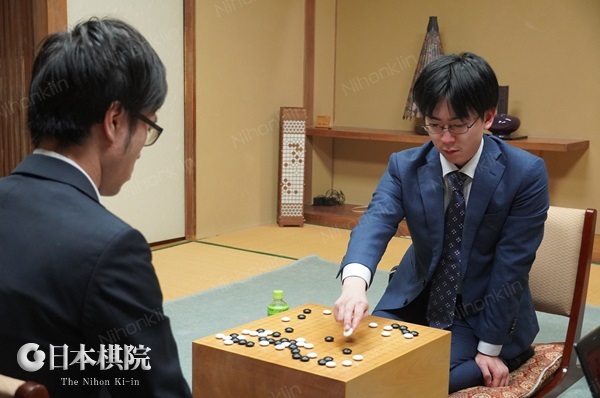
NOTE: This is #3 in a series of reports covering the second half of 2025. The order is based on the date of the final deciding game in the tournament.
Shibano becomes Kisei challenger
In the 51st Kisei S League, Shibano Toramaru Judan and Kyo Kagen 9-dan both finished with 4–1 scores, but, as the higher-ranked player, Shibano took precedence. In the A League, Takao Shinji 9-dan took first place with 6–1. In the B1 League, Cho U came first with 6–1; in the B2 League, Otake Yu 7-dan won with the same score. In the play-off between the leagues, Cho prevailed. In the C League, Fukuoka Kotaro came first with a score of 5–0.
In the irregular knockout to decide the challenger, Fukuoka caused a stir by beating Cho (Oct. 6) and Takao (Oct. 20), but he was stopped by Kyo on October 20. In the best-of-three final, Kyo won the first game (Oct. 30), but Shibano won the second (Nov. 3). The winner of the S League is given a one-win advantage, so Shibano became the challenger. He is now making his second challenge to Ichiriki Ryo—he lost 2–4 in 2023.
Ding wins 1st Yangming Cup
This is yet another international tournament for professionals. The full name is The 2025 Yangming Cup China, Japan and Korea Invitational Tournament. It is organized/sponsored by the Chinese Weiqi Association, the Guizhou Province Physical Education Department, and the Guiyang City People’s Government (Guiyang is the capital of the province). The tournament is named after the philosopher Wang Yangming, who had local roots. It is the only full-scale international tournament I know of that is purely invitational.
Over the years, sponsors of quite a few tournaments have made provision for one or two “wild cards,” that is, invited players, but usually most of the players are chosen by the go organizations in each country.
Sixteen players—eight from China and four each from Korea and Japan—took part in the first tournament, held in Guiyang City from October 30 to November 3. It was a knockout, with a one-game final. The time allowance was 100 minutes per player, with 30 seconds added for each move (the Fischer format). First prize was 400,000 yuan ($57,554, at $1 = 6.95 yuan), second 150,000, third and fourth 50,000, and fifth to eighth 30,000; the eight players who lost in the first round received a game fee of 20,000.
With their numerical advantage, it was not surprising that the finalists were both Chinese. In the game played on November 3, Ding Hao 9-dan (W) beat Tu Xiaoyu 9-dan by resignation. With this win, Ding now holds five domestic and international titles; he is considered to have a good chance of supplanting Shin Jinseo 9-dan of Korea (who, for reasons unknown to me, did not play in this tournament), but Shin remains number one and Ding is second. Results of the other games are given below. Note that only one non-Chinese player made it to the second round.
Round 1 (Oct. 31). Park Junghwan 9-dan (Korea) beat Yang Kaiwen (China); Fan Tingyu 9-dan (China) (W) beat Hirose Yuichi 7-dan (Japan) by resig.; Tu Xiaoyu 9-dan (China) (B) beat Yo Seiki 8-dan (Japan) by resig.; Li Weiqing 9-dan (China) beat Shin Minjun 9-dan (Korea); Xu Jiayang 9-dan (China) beat Kang Dongyun 9-dan (Korea); Wang Xinghao 9-dan (China) (B) beat Iyama Yuta 9-dan (Japan) by resig.; Tang Weixing 9-dan (China) (W) beat Otake Yu 7-dan (Japan) by resig.; Ding Hao 9-dan (China) beat Lee Jihyun 9-dan (Korea).
Round 2 (Nov. 1). Han beat Park; Tu beat Li; Wang beat Xu; Ding beat Tang.
Semifinals (Nov. 2). Tu beat Han; Ding beat Wang.
Fujisawa defends Women’s Honinbo
The 44th Women’s Honinbo title match featured a clash between Fujisawa Rina, the defending champion, and Hoshiai Chiho 4-dan, making her second challenge. In the 40th title match, played in 2021, Fujisawa beat Hoshiai 3–0. This time, the challenger put up much stronger resistance, and a hard-fought match ensued.
In the first game, Fujisawa played calmly and precisely, and the challenger could not match the sharpness of her play. The second game was a different story. Hoshiai took the lead in a ko fight in the middle game, but Fujisawa—nicknamed “the half-point queen”—played tenaciously and reduced the margin to a half point. Hoshiai then played magnificently in the endgame to gain a full point, giving her a slightly more comfortable win. Referring to her one-sided loss four years earlier, she commented that she was happy to pick up her first title-match win against Fujisawa.
In the third game, Hoshiai again took the early lead, but subsequent slack play let Fujisawa catch up and take control. In the fourth game, slack play by Fujisawa allowed Hoshiai to even the score. In the final game, Hoshiai, pessimistic about her position, made an overplay; Fujisawa took advantage of that to secure the win. This is her sixth successive term in the title and her ninth overall.
Game 1 (Sept. 24; Kashoen, Hanamaki City, Iwate Prefecture). Fujisawa (W) by resig.
Game 2 (Oct. 7; Nihon Ki-in, Tokyo). Hoshiai (W) by 1.5 points.
Game 3 (Oct. 14). Fujisawa (W) by resig.
Game 4 (Oct. 22). Hoshiai (W) by 1.5 points.
Game 5 (Nov. 5). Fujisawa (B) by resig.
Fujisawa: “I felt that this was a really tough title defense for me—every game was a struggle. It hasn’t come home to me yet that I’ve won the title for six years in a row. Defending it every year has been a stern test. Being able to play in the title match again next year is an honor.”
Hoshiai: “This year I started out in the preliminaries. I didn’t expect to win my way through the main tournament and become the challenger. Taking the match the full distance shows that I did my best.”
Sumire wins first Korean title
About a year and a half after switching allegiance to the Korean Baduk Association, Nakamura Sumire has won her first Korean title. In the final of the 4th Hyorim Future Empress Strongest Player tournament, held on November 6, she beat Cheong Yujin 5-dan. Taking black, she won by resignation.
This tournament is for female players born after 2002. It is a TV tournament, played in the studio at the Korean Baduk Association headquarters. The time limit is 20 minutes per player plus 20 seconds per move (Fischer system). First prize is 10,000,000 won (about $6,854). Sumire is ranked 4th among Korean women players; Cheong is 18th.