By Anna Vital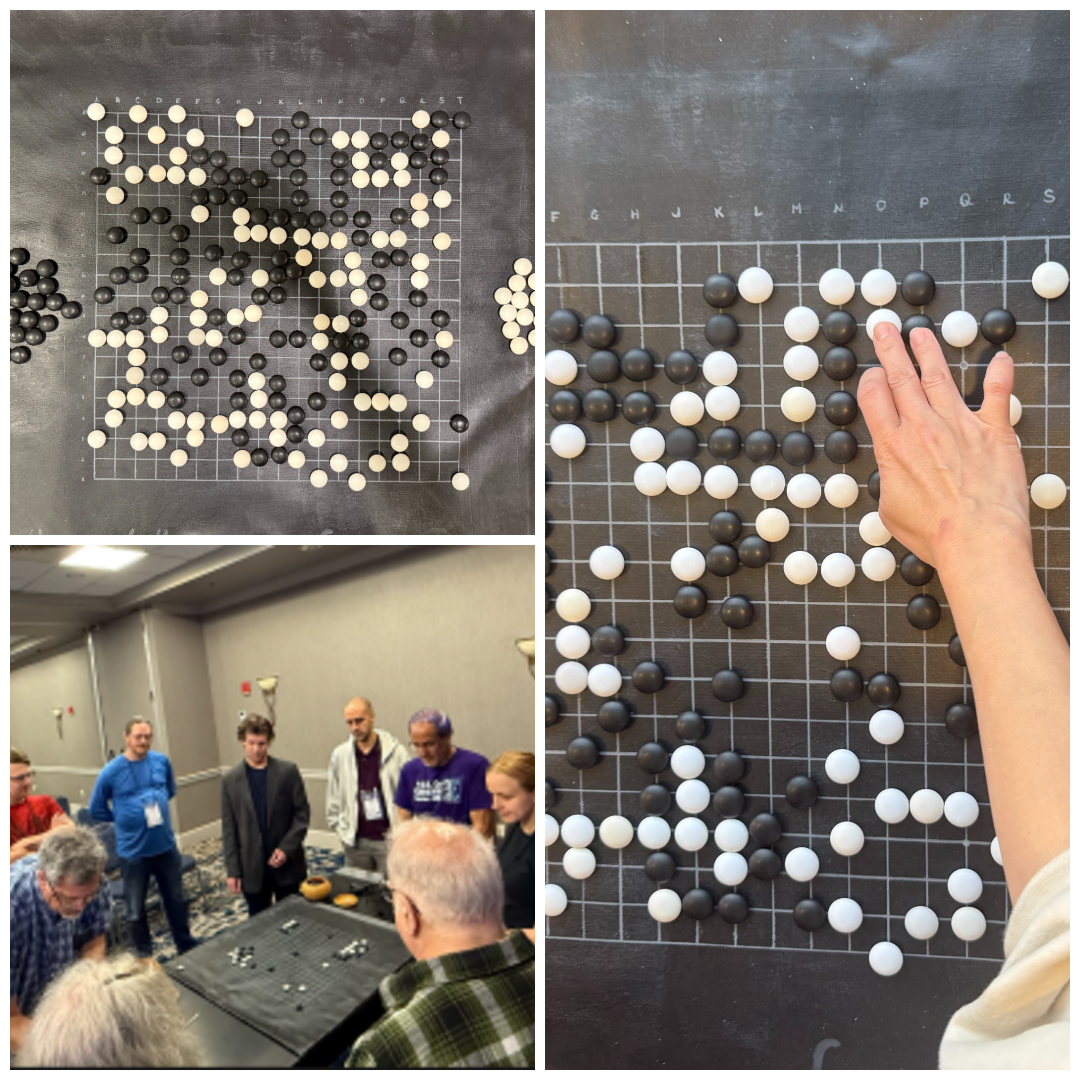
Classical Zen Go is a variation of Go played by three people who alternate between playing Black and White. But what happens when an entire Go Congress contributes to a single game?
That was the idea behind Zen Go, a participatory art installation I created for the 42nd U.S. Go Congress in Boston last month.
We started with an empty board and four instructions:
- Black to move.
- One move per player.
- Chinese rules.
- Record your move in the kifu.
The game began at tengen.
Then came the corners. Then someone played at T19.
"Who went here?" players wondered, studying moves left behind by people they would probably never identify.
"What if I resign?" others asked. No one did.
Beginners, experienced players, and professionals all contributed moves. Michael Redmond played one. Players recorded their initials alongside their moves in the kifu.
Over the course of the Congress, the game changed dramatically. At one point, Black seemed to have no chance; later, Black was alive again. Some people returned to the board repeatedly just to see how the game had evolved.
Keeping the kifu accurate became a collective effort of its own. Errors crept in more than once, and players noticed and corrected them. Eventually, we began recording two kifus in parallel to minimize mistakes.
Toward the end of the Congress, I changed the rule to allow one move per player per day in order to speed the game along. By the end of the week, 189 moves had been played.
But what fascinated me most was what happened when everyone could influence the game and no one could control it.
Each player encountered a position created by strangers, made a single decision, and walked away. The next player inherited everything that had come before.
No player could have a strategy extending beyond a single move.
And yet there was a game.